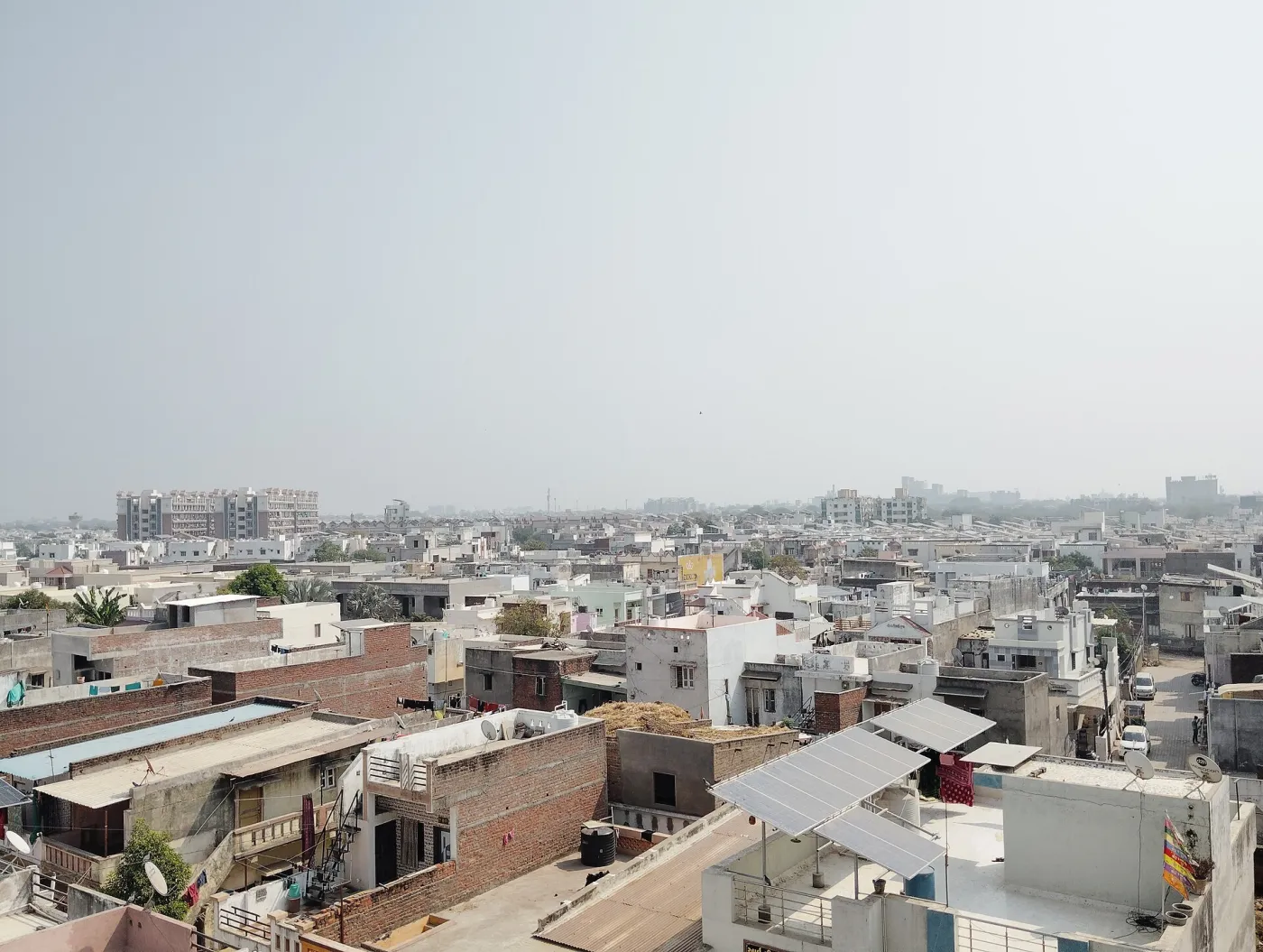
Rooftop solar on homes in Mehsana, Gujarat.
What rooftop solar costs in India, and what it actually saves
Photo by Nizil Shah, CC BY-SA 4.0

Residential rooftop solar costs about ₹55,000 to ₹70,000 per kW installed. Commercial and industrial systems drop to ₹38,000 to ₹50,000 per kW because of scale.
So a 3 kW home system is roughly ₹1.8–2.1 lakh before subsidy, a 50 kW commercial plant is ₹20–25 lakh, and a 100 kW industrial plant is ₹37–50 lakh. Expect about 100 sq ft of shade-free roof per kW, and 1,400–1,600 units generated per kW per year.
The thing most quotes bury is that the per-kW rate falls sharply as the system gets bigger. If you take a home installer's rate and multiply it by your factory's kW, you will overestimate the cost by 40%. Conversely, a commercial rate quoted for a 3 kW home job is a sign the vendor has not costed the scaffolding and single-phase inverter properly.
Who solar pays off fastest for
Your payback is driven by one number: what you currently pay per unit. Every unit you self-generate saves you that full tariff. A commercial consumer paying ₹10–12 saves nearly twice as much per unit as a home on a ₹7 slab — which is why commercial payback lands at three to five years and residential at four to six even with the subsidy.
Send this to us on WhatsApp
Send on WhatsAppOpens a chat on +91 77788 04214. Nothing is stored here — you press send. Free for buyers: manufacturers pay us when a deal closes.
Your message
System sizes, costs and roof area
Indicative installed cost before subsidy. Roof area assumes a standard flat or sheet roof with no significant shading.
| System | Installed cost | Central subsidy | Roof area | Units/year | Typical fit |
|---|---|---|---|---|---|
| 3 kW residential | ₹1.8 L–₹2.1 L | ₹78,000 | 300 sq ft | 4,500 | A 2–3 BHK home with a monthly bill around ₹2,000–3,000 |
| 5 kW residential | ₹2.8 L–₹3.3 L | ₹78,000 | 500 sq ft | 7,500 | A villa or bungalow with air conditioning and a monthly bill above ₹4,000 |
| 25 kW commercial | ₹11.0 L–₹14.0 L | — | 2,500 sq ft | 37,500 | A shop complex, clinic, small hotel or office floor |
| 50 kW commercial | ₹20.0 L–₹25.0 L | — | 5,000 sq ft | 75,000 | A school, hospital wing, housing society common load, or mid-size office |
| 100 kW industrial | ₹37.0 L–₹50.0 L | — | 10,000 sq ft | 1,50,000 | A factory shed, cold storage, or warehouse with daytime load |
| 500 kW industrial | ₹1.90 cr–₹2.50 cr | — | 50,000 sq ft | 7,50,000 | A full manufacturing plant or large logistics park |
Generation assumes 1,500 units per kW per year, which is about right for Gujarat, Rajasthan and most of central India. Coastal and high-rainfall regions run 10–15% lower.
The PM Surya Ghar subsidy, accurately
Up to ₹78,000, and only for residential rooftops. The structure is ₹30,000 for the first kW, ₹60,000 for 2 kW, and ₹78,000 for anything 3 kW and above.
That cap matters more than people realise. A 10 kW home system receives the same ₹78,000 as a 3 kW one, so the subsidy is proportionally far more valuable on a small system. If you are sizing a home system purely for subsidy efficiency, 3 kW is the sweet spot — though if your consumption justifies more, the extra capacity still pays for itself on tariff savings alone.
Commercial, industrial and institutional rooftops get no central subsidy under this scheme. Their economics come from tariff savings plus accelerated depreciation, which for a profitable business is frequently worth more than the residential subsidy is to a homeowner. Have your CA confirm how it applies to your entity — we are not tax advisors.
A few states layer their own incentives on top. Delhi, for instance, adds a generation-based incentive for small residential systems. Our city pages carry the local position. Full subsidy guide →
Net metering is where savings are won or lost
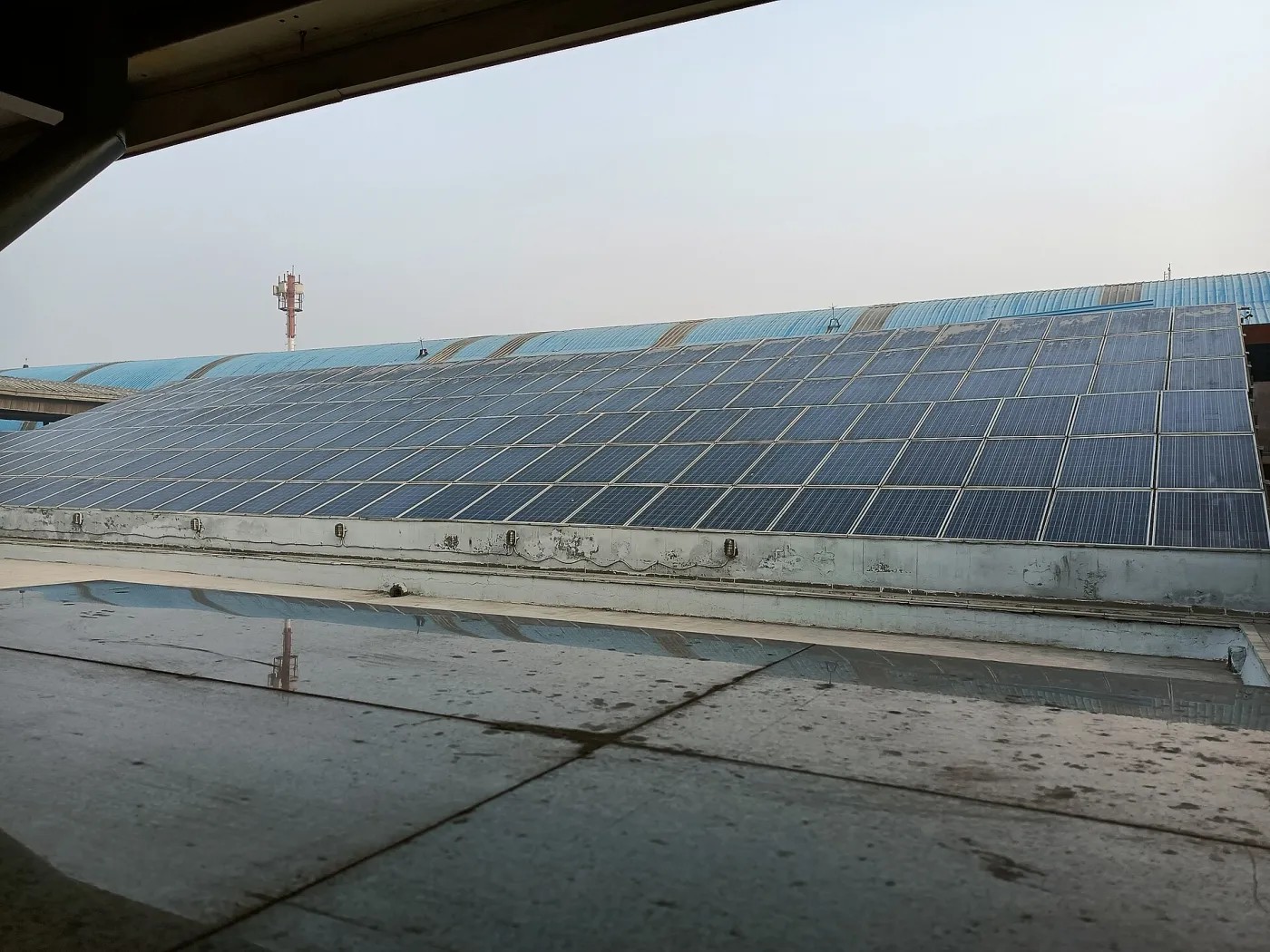

Solar generates during the day. If your building consumes during the day, you save your full tariff on every unit. If it consumes in the evening, those units have to go somewhere — and what you get for them depends on your state's net-metering policy.
- Net metering credits exported units against units you import, so you are billed on the net. This is the best case and effectively saves your full tariff.
- Net billing or gross metering pays you a fixed export rate, usually well below your retail tariff. Savings drop accordingly.
- Caps and restrictions exist almost everywhere — commonly a limit tied to a percentage of your sanctioned load, and tighter rules for commercial consumers than residential.
This is why our calculator lets you set what share of generation you consume on site, and credits the rest at 70% of tariff rather than 100%. Vendor calculators almost universally assume 100%, which overstates savings for any building that empties out at 6pm.
The factories where solar works best
The ideal profile is a continuous daytime load with a large sheet roof: textile processing, engineering and casting units, cold storage, plastics, dairy, pharma. These consume nearly everything they generate, so almost every unit saves full commercial tariff, and roof area is never the constraint.
The worst profile is a building with high evening load and little roof — a restaurant in a high-rise, say. Solar can still work there, but the honest answer is often that the numbers are mediocre, and we will tell you that. More on commercial and industrial solar →
Work out your own payback
Set your real tariff from your last bill. That single number moves the answer more than anything else on this page.
Indicative only, and deliberately includes the costs vendor calculators leave out. It excludes rent, staff, GST treatment and your DISCOM's specific demand-charge structure.
Indicative planning numbers. Real figures depend on your roof structure, shading, your state's net-metering terms and your sanctioned load.
If you are also thinking about EV charging, do them together
A charging station's single biggest running cost is electricity, which is exactly what solar removes. And both projects need the same site survey, the same sanctioned-load study and the same electrical contractor.
Buyers who install solar a year after their charger routinely pay for that groundwork twice, and sometimes pay for a second transformer upgrade that one combined plan would have avoided.
Quick sanity check
Take your monthly bill, divide by your per-unit tariff to get your monthly units, then divide by 120. That is roughly the kW of solar you need to cover your consumption.
A ₹60,000 monthly bill at ₹10 a unit is 6,000 units, which is about 50 kW of solar and roughly 5,000 sq ft of roof. If you do not have that roof, you size to the roof and save proportionally.
Solar cost questions
How much does rooftop solar cost in India in 2026?
Residential rooftop solar runs about ₹55,000–70,000 per kW installed, and commercial or industrial systems drop to ₹38,000–50,000 per kW because of scale. So a 3 kW home system is roughly ₹1.8–2.1 lakh before subsidy, a 50 kW commercial plant is ₹20–25 lakh, and a 100 kW industrial plant is ₹37–50 lakh. Price per kW falls as system size rises, which is why small systems have a worse raw payback than large ones even with the subsidy.
How much subsidy do I get under PM Surya Ghar?
Up to ₹78,000, and only for residential rooftops. The structure is ₹30,000 for the first kW, ₹60,000 for 2 kW, and ₹78,000 for any system of 3 kW or more — the subsidy is capped there, so a 10 kW home system receives the same ₹78,000 as a 3 kW one. Commercial, industrial and institutional rooftops get no central subsidy at all under this scheme; their economics come from tariff savings and accelerated depreciation instead.
How much roof area do I need for solar?
Roughly 100 square feet per kW for a standard rooftop installation. So 3 kW needs about 300 sq ft of shade-free roof, 50 kW needs about 5,000 sq ft, and 100 kW needs around 10,000 sq ft. Elevated structures over parking or sheds can reduce the footprint penalty, and high-efficiency panels shave perhaps 10–15% off the area, but the 100 sq ft per kW rule is the right starting point for planning.
What is the payback period for commercial solar?
Typically three to five years for a commercial or industrial system, and four to six years for residential after subsidy. The driver is your current tariff: if you pay ₹9–12 per unit as a commercial consumer, every unit you self-generate saves that full amount, so payback is fast. A home paying ₹7 per unit in a low slab saves less per unit and takes longer. Panels are warranted for 25 years, so everything after payback is effectively free power.
How many units will my solar system generate?
About 4 to 4.5 units per kW per day in most of India, or roughly 1,400–1,600 units per kW per year. Gujarat and Rajasthan sit at the top of that range thanks to high irradiance; coastal and high-rainfall regions sit lower. For a quick estimate, multiply system size in kW by 4 to get daily units — a 50 kW plant produces around 200 units a day, or about 6,000–7,000 units a month.
What is net metering and how does it affect my savings?
Net metering lets you export surplus daytime generation to the grid and offset it against what you draw at night, so you are billed only on the net. This is what makes solar work for buildings whose load does not match the sun. The catch is that net-metering caps and rules vary sharply by state — some states limit commercial net metering, restrict system size to a percentage of sanctioned load, or offer only net billing at a lower export rate. Confirm your state's current policy before sizing a system.
Can a business claim depreciation on solar?
Yes. Solar power generating systems qualify for accelerated depreciation under the Income Tax Act, which lets a profitable business write off a large share of the asset value in the early years and substantially improves post-tax returns. This is often worth more to a commercial buyer than the residential subsidy is to a homeowner. The exact rate and how it applies to your entity depends on your tax position, so have your CA confirm it before you model returns — we are not tax advisors.
Does solar make sense together with an EV charging station?
Yes, and it is the single best combination in this market, because an EV charging station's biggest running cost is electricity. A solar array sized to your daytime charging load replaces grid units costing ₹8–12 with self-generated units costing effectively nothing after payback, which widens your margin on every kWh you sell. The two also share infrastructure: the same site survey, the same load study, the same electrical contractor and often the same transformer upgrade. Doing them together is materially cheaper than doing them a year apart.
What maintenance does solar need?
Panel cleaning every two to four weeks and an annual electrical inspection. Dust is the main enemy in India — an uncleaned array can lose 15–25% of output in a dusty industrial area. There are no moving parts, so failures are rare; the inverter is the component most likely to need replacement, typically once in the system's life at around 10–12 years. Most commercial installers offer an AMC covering cleaning, monitoring and inverter support.
What happens to solar output during monsoon and at night?
Output drops roughly 40–60% on heavily overcast monsoon days and is zero at night, which is exactly what net metering or a battery is for. A grid-connected system without batteries simply draws from the grid when the sun is not producing, and your annual generation estimate already averages the monsoon in — which is why solar is sized against annual units, not best-day output. Batteries only make financial sense if you need backup power anyway or your state has poor net-metering terms.
Solar by city
Irradiance, local DISCOM and net-metering terms all change your numbers. Pick your city.
Get solar quotes for your roof
Tell us your city, your monthly bill and roughly how much shade-free roof you have. We verify it on a call and send the same brief to vendors who work in your area.
Free for buyers. Call +91 77788 04214 if you would rather talk it through.