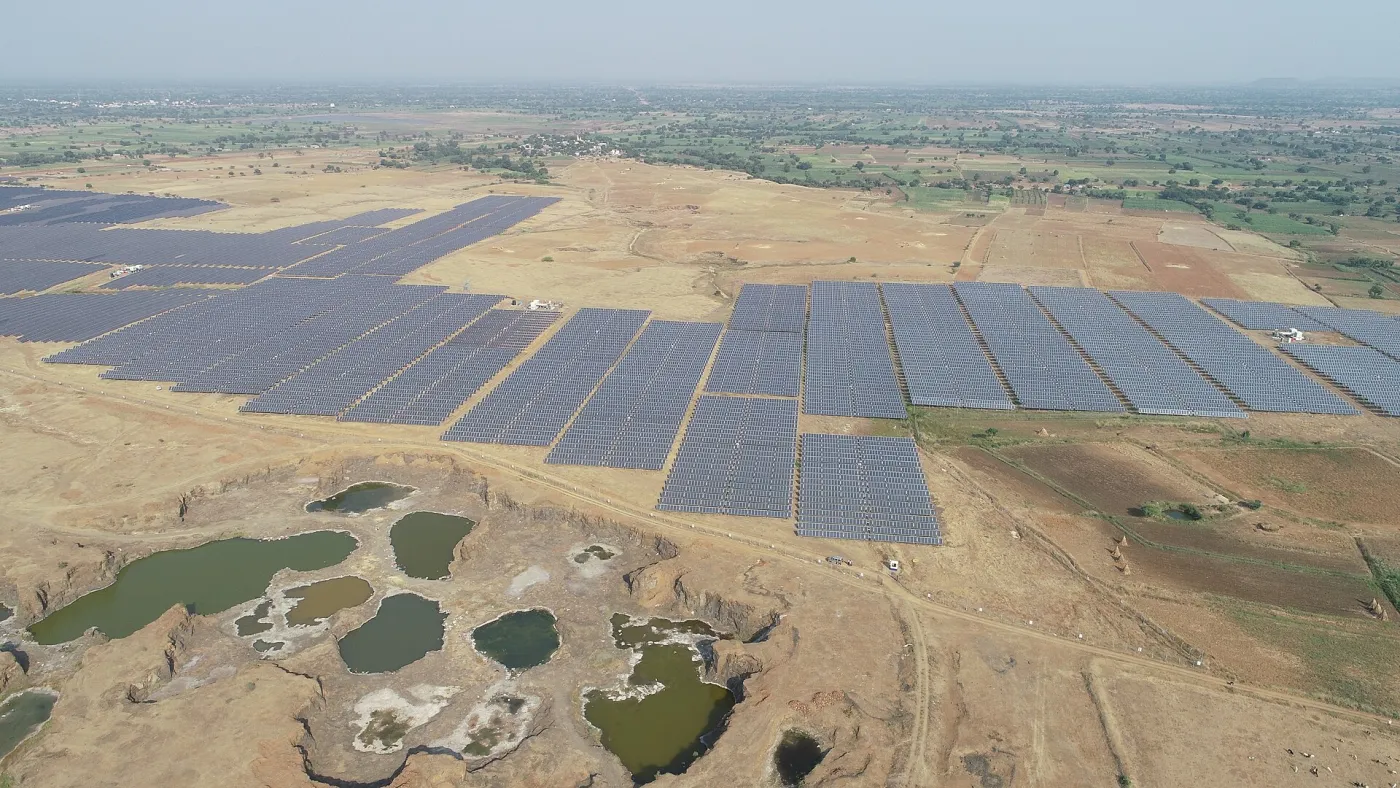
A commercial solar plant in Maharashtra.
Solar for factories, warehouses and commercial buildings
Photo by Thomas Lloyd Group, CC BY-SA 4.0

Commercial and industrial rooftop solar costs Rs 38,000 to Rs 50,000 per kW installed and typically pays back in three to five years.
There is no central subsidy for these rooftops. The return comes from two places: saving your full commercial tariff on every unit you generate, and accelerated depreciation against taxable profit.
For most commercial consumers this is the fastest-paying asset on the building, and the reason is simply that you pay Rs 9-12 a unit while a home pays Rs 7. Higher tariff, faster payback.
The load profile that matters
Solar generates between roughly 8am and 5pm. The closer your consumption sits inside that window, the better your economics, because self-consumed units save full tariff while exported units earn whatever your state's export terms allow.
- Excellent: textile processing, engineering and casting, cold storage, plastics, dairy, pharma, data rooms, hospitals, schools, IT offices
- Good: hotels, malls, warehouses with daytime operations, housing society common load
- Harder: restaurants and venues with evening-weighted load, high-rises with little roof per unit of consumption
Send this to us on WhatsApp
Send on WhatsAppOpens a chat on +91 77788 04214. Nothing is stored here — you press send. Free for buyers: manufacturers pay us when a deal closes.
Your message
Accelerated depreciation
Solar power generating systems qualify for accelerated depreciation under the Income Tax Act, letting a profitable business write off a large share of the asset value in the early years. For a company paying tax, this frequently improves the effective return more than any subsidy would.
How much it is worth depends entirely on your tax position, your entity type and the year you commission. Have your CA model it before you rely on it. We are not tax advisors and will not pretend otherwise — but we will make sure the vendor quotes you a number your CA can actually work with.
Three ways to pay for it
- CAPEX. You buy the system, you own the asset, you claim the depreciation, you keep all the savings. Best return if you have the cash and a tax position to use.
- OPEX or RESCO. A developer builds and owns the plant on your roof and sells you power at a fixed per-unit rate below your tariff. No capital outlay, lower savings, and you are signing a 15-25 year PPA — read the escalation clause carefully.
- Debt. Many banks now lend against commercial solar at rates below the effective savings, which makes the project cash-positive from month one.
Net metering is the risk to check first
Commercial net-metering rules are tighter than residential almost everywhere, and in several states commercial consumers get net billing at a low export rate rather than true net metering. That single policy detail can swing your payback by two years, which is why we establish it before a vendor sizes anything.
The practical consequence: size to your daytime consumption, not to your roof. An oversized array on bad export terms is the most common way commercial solar disappoints in India.
What to check in a commercial quote
- Module make, wattage and warranty — performance warranty separate from product warranty
- Inverter make and whether replacement is in the AMC
- Mounting structure specification and wind-load rating for your location
- Roof penetration method and the waterproofing guarantee
- Generation guarantee, in units per year, with a remedy if it is missed
- AMC scope: cleaning frequency, monitoring, response time
- Who handles the DISCOM net-metering application
Size a commercial system
Set your real tariff and be realistic about how much of your load is daytime.
Indicative only, and deliberately includes the costs vendor calculators leave out. It excludes rent, staff, GST treatment and your DISCOM's specific demand-charge structure.
Indicative planning numbers. Real figures depend on your roof structure, shading, your state's net-metering terms and your sanctioned load.
Commercial solar questions
What is the payback period for commercial solar?
Typically three to five years for a commercial or industrial system, and four to six years for residential after subsidy. The driver is your current tariff: if you pay ₹9–12 per unit as a commercial consumer, every unit you self-generate saves that full amount, so payback is fast. A home paying ₹7 per unit in a low slab saves less per unit and takes longer. Panels are warranted for 25 years, so everything after payback is effectively free power.
Can a business claim depreciation on solar?
Yes. Solar power generating systems qualify for accelerated depreciation under the Income Tax Act, which lets a profitable business write off a large share of the asset value in the early years and substantially improves post-tax returns. This is often worth more to a commercial buyer than the residential subsidy is to a homeowner. The exact rate and how it applies to your entity depends on your tax position, so have your CA confirm it before you model returns — we are not tax advisors.
What is net metering and how does it affect my savings?
Net metering lets you export surplus daytime generation to the grid and offset it against what you draw at night, so you are billed only on the net. This is what makes solar work for buildings whose load does not match the sun. The catch is that net-metering caps and rules vary sharply by state — some states limit commercial net metering, restrict system size to a percentage of sanctioned load, or offer only net billing at a lower export rate. Confirm your state's current policy before sizing a system.
How many units will my solar system generate?
About 4 to 4.5 units per kW per day in most of India, or roughly 1,400–1,600 units per kW per year. Gujarat and Rajasthan sit at the top of that range thanks to high irradiance; coastal and high-rainfall regions sit lower. For a quick estimate, multiply system size in kW by 4 to get daily units — a 50 kW plant produces around 200 units a day, or about 6,000–7,000 units a month.
What maintenance does solar need?
Panel cleaning every two to four weeks and an annual electrical inspection. Dust is the main enemy in India — an uncleaned array can lose 15–25% of output in a dusty industrial area. There are no moving parts, so failures are rare; the inverter is the component most likely to need replacement, typically once in the system's life at around 10–12 years. Most commercial installers offer an AMC covering cleaning, monitoring and inverter support.
Get commercial solar quotes
Tell us your monthly bill, roughly how much roof you have and whether your load is daytime. We will send the same brief to installers who do work at your scale.
Call +91 77788 04214.