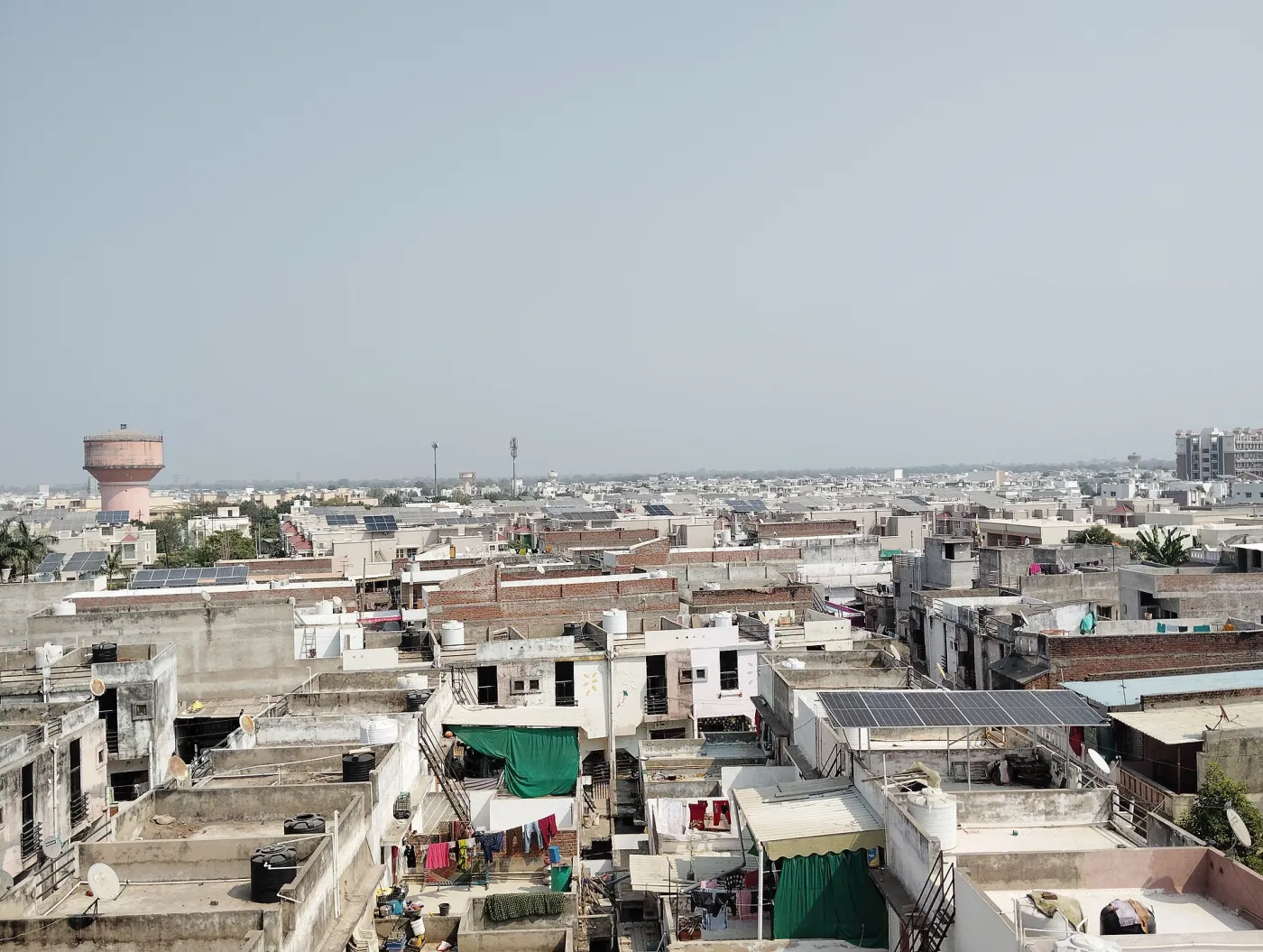
Residential rooftop arrays in Mehsana, Gujarat — the segment the subsidy is for.
The PM Surya Ghar subsidy, exactly
Photo by Nizil Shah, CC BY-SA 4.0
.jpg)
Up to Rs 78,000, and only for residential rooftops. Rs 30,000 for the first kW, Rs 60,000 for 2 kW, Rs 78,000 for anything 3 kW and above.
The cap matters: a 10 kW home system receives the same Rs 78,000 as a 3 kW one.
Commercial, industrial and institutional rooftops get nothing under this scheme. Their economics come from tariff savings plus accelerated depreciation, which for a profitable business is frequently worth more than this subsidy is to a homeowner.
Send this to us on WhatsApp
Send on WhatsAppOpens a chat on +91 77788 04214. Nothing is stored here — you press send. Free for buyers: manufacturers pay us when a deal closes.
Your message
| System size | Central subsidy | Indicative cost | Net cost | Suits |
|---|---|---|---|---|
| 1 kW | Rs 30,000 | Rs 65-75k | Rs 35-45k | A small flat with a modest bill |
| 2 kW | Rs 60,000 | Rs 1.2-1.4 L | Rs 60-80k | A 2 BHK without heavy air conditioning |
| 3 kW | Rs 78,000 | Rs 1.8-2.1 L | Rs 1.0-1.3 L | The subsidy sweet spot — best value per rupee of subsidy |
| 5 kW | Rs 78,000 | Rs 2.8-3.3 L | Rs 2.0-2.5 L | A villa or bungalow with air conditioning |
| 10 kW | Rs 78,000 | Rs 5.5-6.5 L | Rs 4.7-5.7 L | A large home; subsidy is now a small share of cost |
Who is eligible
- Indian residential consumers who own the roof, or have the housing society's consent
- A valid domestic electricity connection in the applicant's name
- A roof structurally able to carry the array, with enough shade-free area
- Installation by a vendor registered on the national portal — this is not optional, and using an unregistered installer forfeits the subsidy
How the process runs
- Register on the national PM Surya Ghar portal with your DISCOM and consumer number
- Apply for feasibility approval from your DISCOM
- Pick a registered vendor and get the system installed
- Apply for net metering; the DISCOM inspects and installs the bidirectional meter
- Submit the commissioning certificate and your bank details
- Subsidy is credited directly to your bank account, typically within a few weeks
The subsidy is reimbursed to you after commissioning — you pay the full amount first. Any vendor claiming they will "adjust the subsidy in the quote" is either financing it for you (ask the interest rate) or misunderstanding the scheme.
State top-ups
A few states add their own incentives. Delhi offers a generation-based incentive for small residential systems; Uttar Pradesh has offered an additional state subsidy. Most states, including Gujarat, rely on the central scheme alone. Check your state's current position rather than trusting a vendor's claim, since these change with each budget.
Subsidy amounts and process steps change. Verify current terms on the official PM Surya Ghar portal before budgeting. This is not financial or legal advice.
What solar costs in India · Commercial rooftops, where this subsidy does not apply
Subsidy questions
How much subsidy do I get under PM Surya Ghar?
Up to ₹78,000, and only for residential rooftops. The structure is ₹30,000 for the first kW, ₹60,000 for 2 kW, and ₹78,000 for any system of 3 kW or more — the subsidy is capped there, so a 10 kW home system receives the same ₹78,000 as a 3 kW one. Commercial, industrial and institutional rooftops get no central subsidy at all under this scheme; their economics come from tariff savings and accelerated depreciation instead.
How much does rooftop solar cost in India in 2026?
Residential rooftop solar runs about ₹55,000–70,000 per kW installed, and commercial or industrial systems drop to ₹38,000–50,000 per kW because of scale. So a 3 kW home system is roughly ₹1.8–2.1 lakh before subsidy, a 50 kW commercial plant is ₹20–25 lakh, and a 100 kW industrial plant is ₹37–50 lakh. Price per kW falls as system size rises, which is why small systems have a worse raw payback than large ones even with the subsidy.
What is net metering and how does it affect my savings?
Net metering lets you export surplus daytime generation to the grid and offset it against what you draw at night, so you are billed only on the net. This is what makes solar work for buildings whose load does not match the sun. The catch is that net-metering caps and rules vary sharply by state — some states limit commercial net metering, restrict system size to a percentage of sanctioned load, or offer only net billing at a lower export rate. Confirm your state's current policy before sizing a system.
Can a business claim depreciation on solar?
Yes. Solar power generating systems qualify for accelerated depreciation under the Income Tax Act, which lets a profitable business write off a large share of the asset value in the early years and substantially improves post-tax returns. This is often worth more to a commercial buyer than the residential subsidy is to a homeowner. The exact rate and how it applies to your entity depends on your tax position, so have your CA confirm it before you model returns — we are not tax advisors.
How much roof area do I need for solar?
Roughly 100 square feet per kW for a standard rooftop installation. So 3 kW needs about 300 sq ft of shade-free roof, 50 kW needs about 5,000 sq ft, and 100 kW needs around 10,000 sq ft. Elevated structures over parking or sheds can reduce the footprint penalty, and high-efficiency panels shave perhaps 10–15% off the area, but the 100 sq ft per kW rule is the right starting point for planning.
Get quotes from registered installers
Using a vendor registered on the national portal is what makes you eligible. Every installer we route residential work to is registered.
Call +91 77788 04214.