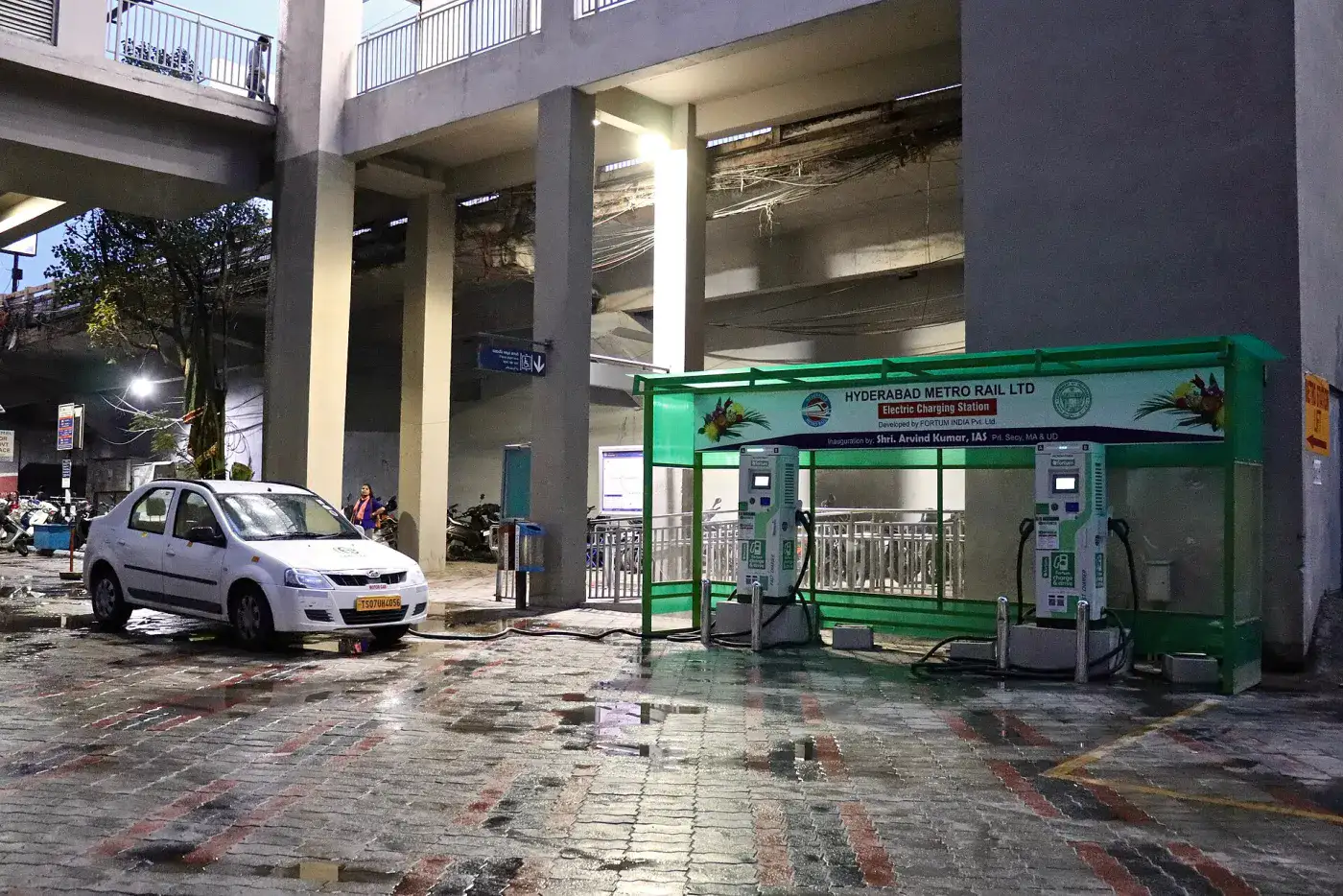
A public station under the metro at Begumpet, Hyderabad.
The EV charging business, without the optimism
Photo by iMahesh, CC BY-SA 4.0

A well-sited 60 kW station realistically clears Rs 25,000 to Rs 80,000 a month in gross margin in year one. The same hardware at two cars a day loses money every month.
This is a utilisation business, not a hardware business. Two owners can buy the identical charger from the identical vendor and one earns four times what the other does, entirely because of where it sits and who drives past.
The arithmetic
Six cars a day at 25 kWh a session is 4,500 units a month. Sold at Rs 20 against an Rs 8 power cost, that is Rs 90,000 of revenue and Rs 54,000 of spread. Then subtract:
- Demand charges on your sanctioned load, whether you use it or not
- Platform or network commission, commonly 3-8% of revenue
- AMC, typically Rs 3,000-6,000 a month after the first year
- Rent or opportunity cost of the parking space, if it is not your own
That is how Rs 54,000 of spread becomes Rs 35,000 of real margin.
Send this to us on WhatsApp
Send on WhatsAppOpens a chat on +91 77788 04214. Nothing is stored here — you press send. Free for buyers: manufacturers pay us when a deal closes.
Your message
Picking a site
Site selection is 80% of the outcome. The strongest predictors, in order:
- Dwell time. Somewhere people already spend 30-60 minutes. A charger beside a restaurant beats a charger beside nothing, every time.
- Visibility and easy entry. Drivers will not U-turn for a charger they spot too late, and will not reverse into a tight bay with a 5 m cable.
- Existing sanctioned load. A site with headroom saves you Rs 1-4 lakh and two months.
- Corridor traffic. Highway sites get intercity demand that is independent of local EV ownership, which de-risks you against slow local adoption.
- Safety and lighting. People charge alone at night. Dark, unstaffed sites get avoided.
Outright purchase or franchise
Buy outright if you own the site and want the margin. Take a franchise if you want someone else to own operations.
Outright ownership keeps the full spread between your power cost and retail price, but you also own uptime, payment reconciliation, pricing and customer complaints. Franchise and revenue-share models from network operators hand you a smaller per-unit cut while they run the app, pricing and maintenance; franchise tickets in India commonly start around Rs 30 lakh.
The honest test: do you want a business or an asset? If you will not answer the phone when a driver cannot start a session at 11pm, take the franchise.
The three mistakes that cost the most
- Oversizing. Buying 120 kW for a site that supports 60 kW of demand means paying demand charges on capacity you never sell.
- Skipping OCPP. A non-OCPP charger locks you to one vendor's software forever. It costs nothing to specify 1.6J. Get it in writing.
- Budgeting hardware only. The transformer, the deposit, the demand charges and the commission are where the money actually goes.
Model it honestly
Set cars per day to what you actually believe, then halve it and look again.
Indicative only, and deliberately includes the costs vendor calculators leave out. It excludes rent, staff, GST treatment and your DISCOM's specific demand-charge structure.
Indicative planning numbers. Real figures depend on your roof structure, shading, your state's net-metering terms and your sanctioned load.
Business questions
How much can an EV charging station earn per month?
Realistically ₹25,000–80,000 of gross margin per month for a well-sited 60 kW station in year one. The arithmetic: at 6 cars a day, 25 kWh per session, selling at ₹20/kWh against an ₹8/kWh power cost, you gross about ₹90,000 and keep roughly ₹54,000 before platform commission, rent, AMC and demand charges. Utilisation is everything — the same hardware at 2 cars a day loses money. Be sceptical of any projection that assumes high utilisation from month one.
Should I buy a charger outright or join a franchise?
Buy outright if you own the site and want the margin; take a franchise if you want someone else to run operations. Outright ownership means you keep the full spread between your power cost and retail price, but you own uptime, payment reconciliation and customer complaints. Franchise or revenue-share models from network operators hand you a smaller per-unit cut, typically with the operator managing the app, pricing and maintenance. Franchise investment tickets in India commonly start around ₹30 lakh.
How much land or space do I need for a charging station?
About 25–30 square metres per DC charging bay, including turning space. A two-bay 60 kW station works comfortably in 50–60 sq m, which is roughly two car parking spots plus clearance for the charger, canopy footing and cable movement. You do not need a large plot — you need the right plot, with road visibility, safe entry and exit, and existing sanctioned load nearby.
How long does it take to get an EV charging station running?
Six to twelve weeks if your electrical infrastructure is already adequate, and three to six months if it is not. The charger itself arrives in two to four weeks. What sets your timeline is the DISCOM: a commercial connection on an existing adequate feeder can be sanctioned in three to four weeks, while a transformer upgrade or new feeder can take three months or more depending on your utility.
What hidden costs should I expect beyond the charger price?
Four things that vendors routinely quote separately or not at all: the transformer or sanctioned load upgrade, the DISCOM security deposit, demand charges on your monthly bill, and platform commission on every unit you sell. Demand charges in particular catch people out — a commercial connection bills you on your peak sanctioned demand whether you use it or not, so an underutilised 120 kW connection bleeds money every month. Always compare landed cost and monthly fixed cost, never just hardware price.
Have a site in mind?
Tell us where it is and what your sanctioned load is. We will tell you whether the numbers work before any vendor tries to sell you a charger.
Call +91 77788 04214.