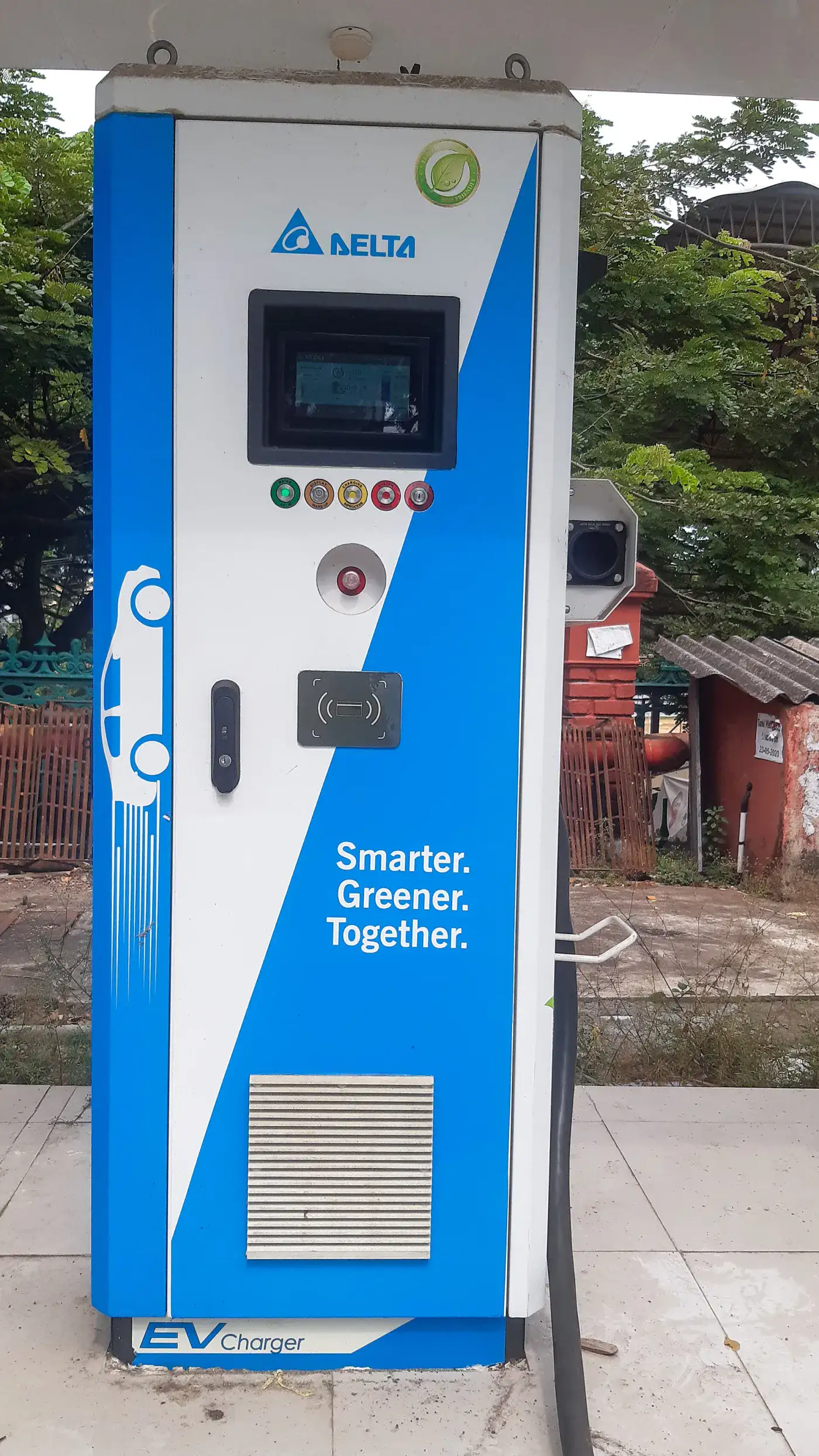
A charging station at the Government Secretariat, Thiruvananthapuram.
EV charging subsidy in India, accurately
Photo by Shagil Kannur, CC BY-SA 4.0

PM E-DRIVE subsidises charging infrastructure heavily, but private site owners cannot apply directly. Applications route through central ministries, CPSEs, autonomous bodies and state or UT governments via appointed nodal agencies.
This is the single most misrepresented fact in the Indian EV charging market. If a vendor offers to "get you the PM E-DRIVE subsidy" for a private petrol pump or hotel, ask them which nodal agency is sponsoring the application. Usually there is no answer.
What the scheme actually funds
- Government buildings with free public access: 100% of both upstream infrastructure and the charging equipment
- Government-owned sites such as airports, toll plazas and bus stations: 80% of upstream infrastructure and 70% of chargers
- Other locations including streets, malls and market complexes: 80% of upstream infrastructure
- Battery swapping stations: 80% of upstream infrastructure
"Upstream infrastructure" means distribution transformers, cables, circuit breakers, protective equipment, mounting structures, fencing and civil works. "EVSE" means the charger and its guns.
Send this to us on WhatsApp
Send on WhatsAppOpens a chat on +91 77788 04214. Nothing is stored here — you press send. Free for buyers: manufacturers pay us when a deal closes.
Your message
| Item | Figure |
|---|---|
| Total allocation | Rs 2,000 crore |
| Chargers targeted | ~72,300 |
| Four-wheeler fast chargers | 22,100 |
| Bus chargers | 1,800 |
| Two and three-wheeler chargers | 48,400 |
| Benchmark cost, up to 50 kW | Rs 6.04 lakh |
| Benchmark cost, above 150 kW | Rs 24 lakh |
| Disbursal | 70% on deployment, 30% on commissioning |
What a private owner can actually get
Several things, none of them PM E-DRIVE capital subsidy direct to you:
- State EV policy incentives. A number of states offer direct capital subsidies, tariff concessions or electricity duty exemptions to private charging operators. These vary widely and change often, so check your state's current policy.
- Concessional EV charging tariffs. Delhi and Maharashtra, among others, have a dedicated EV charging tariff category that is materially cheaper than a general commercial connection. This is often worth more over five years than a one-time capital subsidy.
- De-licensed status. Worth repeating: no licence required, which removes a whole category of cost and delay.
- Partnering with a government tender. If you own land at a strategic location, the realistic route into PM E-DRIVE money is as a site partner to an agency that can apply.
Rules that affect your build regardless
- Compliance with CEA safety regulations and electrical inspectorate approval
- Public charging stations must meet minimum infrastructure norms set by the Ministry of Power
- Many state building codes now require EV-ready provisions in new commercial parking
Policy here changes frequently. Verify current terms on the Ministry of Heavy Industries and your state nodal agency portals before you budget around any of it. We are not advisors and this is not legal advice.
Subsidy questions
What subsidy is available for EV charging stations under PM E-DRIVE?
PM E-DRIVE subsidises charging infrastructure heavily, but private site owners cannot apply directly. Applications route through central ministries, CPSEs, autonomous bodies and state nodal agencies. The scheme allocates ₹2,000 crore for about 72,300 chargers and funds up to 80% of upstream infrastructure at commercial locations, 100% at government buildings with free public access, with benchmark costs from ₹6.04 lakh for chargers up to 50 kW to ₹24 lakh above 150 kW. If a vendor tells you they will "get you the PM E-DRIVE subsidy" for a private petrol pump, ask exactly which nodal agency is sponsoring the application.
Do I need a licence to open an EV charging station in India?
No licence is required. The Ministry of Power has explicitly de-licensed EV charging — operating a public charging station is not a regulated activity, so you do not need a power trading or distribution licence. You do need a commercial electricity connection from your DISCOM with adequate sanctioned load, and your installation must meet CEA safety standards and local electrical inspectorate approval. GST registration applies to the service revenue.
How much does it cost to set up an EV charging station in India?
The equipment price comes from the manufacturer, against your actual specification and order size — we do not publish it, because any published band is wrong for most buyers. What we can tell you is everything else, which is the part that surprises people: civil work and canopy (₹1.5–3 lakh), a transformer or sanctioned load upgrade (₹1–4 lakh), the DISCOM commercial connection with deposits (₹50,000–2 lakh), and commissioning with first-year AMC (₹40,000–1.5 lakh). Most first-time buyers budget only for the charger and get caught by the electrical infrastructure.
How long does it take to get an EV charging station running?
Six to twelve weeks if your electrical infrastructure is already adequate, and three to six months if it is not. The charger itself arrives in two to four weeks. What sets your timeline is the DISCOM: a commercial connection on an existing adequate feeder can be sanctioned in three to four weeks, while a transformer upgrade or new feeder can take three months or more depending on your utility.
Want the honest version for your state?
Tell us where the site is and we will tell you what is actually claimable there, including when the answer is nothing.