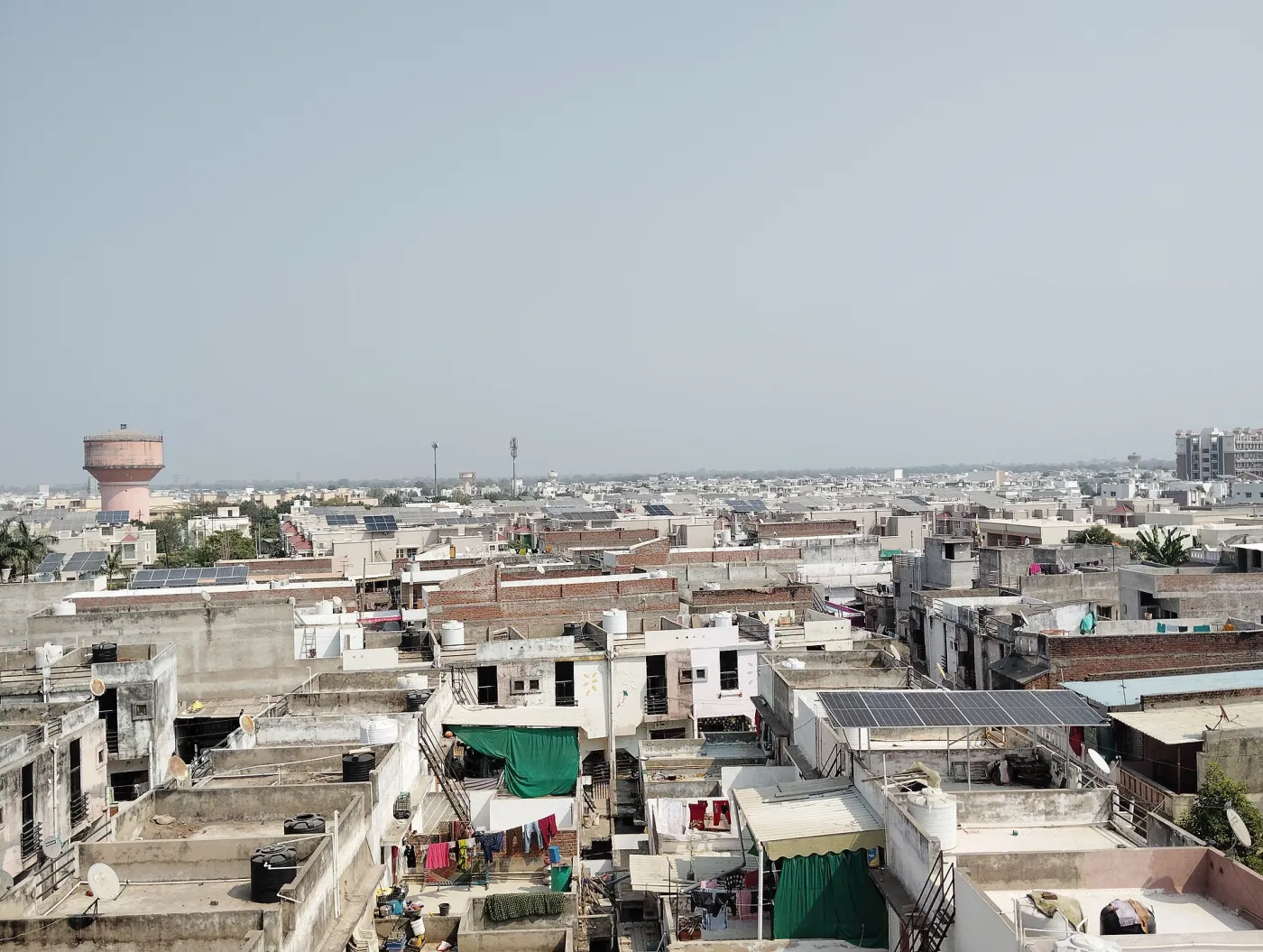
Surat, Gujarat — distribution by DGVCL.
Rooftop solar in Surat
Photo by Nizil Shah, CC BY-SA 4.0
.jpg)
Solar in Surat yields about 1480 units per kW per year — roughly 4.1 units per kW per day. Homes pay ₹55,000–70,000 per kW and claim up to ₹78,000 under PM Surya Ghar; commercial and industrial rooftops pay ₹38,000–50,000 per kW with no central subsidy but accelerated depreciation instead.
Textile processing units in Pandesara, Sachin and Katargam run heavy daytime loads, which is exactly the profile where solar saves the most. Roof area is usually plentiful on industrial sheds.
Your local utility is DGVCL (Dakshin Gujarat Vij Company Ltd), and commercial consumers here pay around ₹7.5–8.9 per unit — which is the number that actually determines your payback, because every unit you generate saves you that full amount.
Rooftop solar quotes in Surat
Your local yield and tariff go in the message, so the quote you get back is costed on your city rather than a national average.
Send on WhatsAppOpens a chat on +91 77788 04214. Nothing is stored here — you press send. Free for buyers: manufacturers pay us when a deal closes.
Your message
A worked example for Surat
A 50 kW commercial rooftop system, costed on local yield and the local commercial tariff band rather than a national average.
- System size
- 50 kW
- Roof area needed, shade-free
- 5,000 sq ft
- Annual generation at Surat yield
- 74,000 units
- Indicative installed cost
- ₹24.0 L
- Annual bill saving
- ₹5,46,120
- Simple payback
- 4.4 years
Assumes 90% of generation is consumed on site or credited at full value, and a mid-point commercial tariff of about ₹8.2 per unit. Accelerated depreciation is not included and typically improves post-tax returns further — confirm with your CA. Panels carry 25-year performance warranties, so everything after payback is effectively free power.
Net metering through DGVCL (Dakshin Gujarat Vij Company Ltd)
DGVCL handles the whole South Gujarat belt. Commercial load sanction here is generally quicker than in Ahmedabad, but transformer capacity in older textile areas is often already committed, which is where surprise upgrade costs come from.
Whether you get full net metering or only net billing at a lower export rate is a state policy question, and it decides how much of your generation is worth full tariff. A building that consumes during the day barely cares. A building that empties at 6pm cares enormously. We establish which one you are before any vendor sizes a system for you, because an oversized array on bad export terms is the most common way solar disappoints in India.
Best candidates in Surat
The ideal profile is continuous daytime load plus a large sheet or flat roof. In Surat that usually means the industrial and commercial pockets around Adajan, Vesu, City Light — plus any housing society looking to cut common-area bills, and any hotel or hospital on a commercial tariff.
Maintenance in local conditions
Dust is the main enemy, and in industrial areas an uncleaned array can lose 15–25% of output. Plan on cleaning every two to four weeks, more often during dry months, and an annual electrical inspection. There are no moving parts, so the inverter is the only component likely to need replacing in the system's life, typically around year 10–12.
Size a system for your Surat roof
The yield slider is pre-set near 1480 for this area — set your tariff from your latest bill.
Indicative only, and deliberately includes the costs vendor calculators leave out. It excludes rent, staff, GST treatment and your DISCOM's specific demand-charge structure.
Indicative planning numbers. Real figures depend on your roof structure, shading, your state's net-metering terms and your sanctioned load.
Thinking about EV charging too?
Surat is a diamond and textile money city with fast-rising premium EV ownership in Vesu, Piplod and City Light. Hotels and commercial complexes in these pockets convert well because residents often cannot install chargers in their own buildings.
A charging station's biggest running cost is the electricity it buys, so solar and charging belong in one plan — one site survey, one load study, often one transformer upgrade.
Local reference numbers
- Solar irradiance
- 5.4 kWh/m²/day
- Annual yield
- 1480 units/kW
- Commercial tariff
- ₹7.5–8.9/unit
- Utility
- DGVCL (Dakshin Gujarat Vij Company Ltd)
Solar questions, answered for Surat
How much does solar cost in Surat?
In Surat, residential rooftop solar runs about ₹55,000–70,000 per kW and commercial or industrial systems ₹38,000–50,000 per kW. So a 3 kW home system is roughly ₹1.8–2.1 lakh before the ₹78,000 PM Surya Ghar subsidy, and a 50 kW commercial plant is about ₹20–25 lakh with no central subsidy but accelerated depreciation available.
How many units will solar generate in Surat?
About 1480 units per kW per year in Surat, which works out to roughly 4.1 units per kW per day. A 50 kW system here generates around 74,000 units a year, or about 6,167 units a month.
What is the payback period for commercial solar in Surat?
Roughly 4.4 years for a 50 kW commercial system in Surat, based on local yield of 1480 units per kW per year and a commercial tariff around ₹7.5–8.9 per unit. Residential payback runs longer at four to six years even after subsidy, because home tariffs are lower so each unit saves less.
Which electricity board handles net metering in Surat?
DGVCL (Dakshin Gujarat Vij Company Ltd). DGVCL handles the whole South Gujarat belt. Commercial load sanction here is generally quicker than in Ahmedabad, but transformer capacity in older textile areas is often already committed, which is where surprise upgrade costs come from. Net-metering caps and whether commercial consumers get full net metering or only net billing vary by state, and that distinction changes your savings materially — it is the first thing we check on the call.
How much subsidy do I get under PM Surya Ghar?
Up to ₹78,000, and only for residential rooftops. The structure is ₹30,000 for the first kW, ₹60,000 for 2 kW, and ₹78,000 for any system of 3 kW or more — the subsidy is capped there, so a 10 kW home system receives the same ₹78,000 as a 3 kW one. Commercial, industrial and institutional rooftops get no central subsidy at all under this scheme; their economics come from tariff savings and accelerated depreciation instead.
How much roof area do I need for solar?
Roughly 100 square feet per kW for a standard rooftop installation. So 3 kW needs about 300 sq ft of shade-free roof, 50 kW needs about 5,000 sq ft, and 100 kW needs around 10,000 sq ft. Elevated structures over parking or sheds can reduce the footprint penalty, and high-efficiency panels shave perhaps 10–15% off the area, but the 100 sq ft per kW rule is the right starting point for planning.
Can a business claim depreciation on solar?
Yes. Solar power generating systems qualify for accelerated depreciation under the Income Tax Act, which lets a profitable business write off a large share of the asset value in the early years and substantially improves post-tax returns. This is often worth more to a commercial buyer than the residential subsidy is to a homeowner. The exact rate and how it applies to your entity depends on your tax position, so have your CA confirm it before you model returns — we are not tax advisors.
Get solar quotes in Surat
Installers who actually work in Surat, quoting against the same brief. Free for buyers.
Call +91 77788 04214 or message us on WhatsApp.
Nearby: Ahmedabad , Vadodara , Rajkot , Gandhinagar
Rooftop solar quotes in Surat
Your local yield and tariff go in the message, so the quote you get back is costed on your city rather than a national average.
Send on WhatsAppOpens a chat on +91 77788 04214. Nothing is stored here — you press send. Free for buyers: manufacturers pay us when a deal closes.
Your message